Category: Design Thinking Toolkit

  • Impact vs Effort Canvas

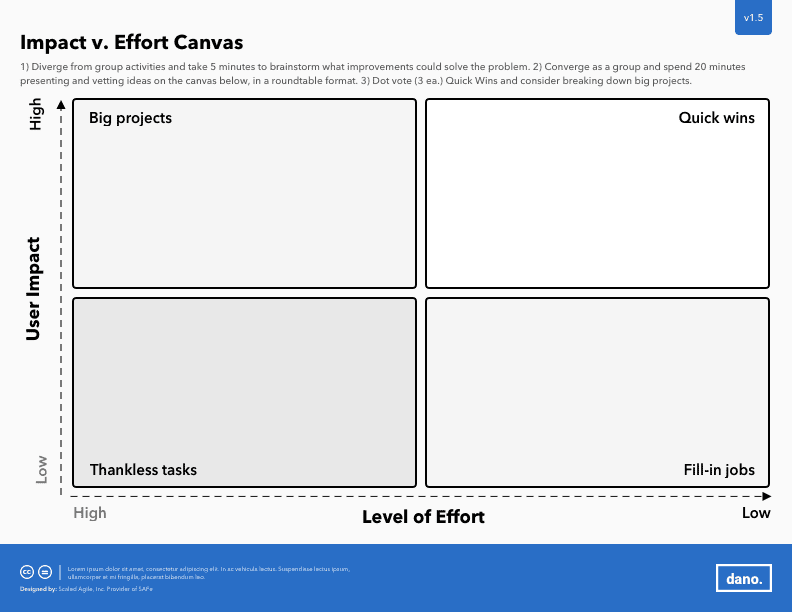
    An Impact versus Effort matrix is a project management and decision-making tool that visually compares the potential impact of tasks or initiatives against the amount of effort required to complete them.

    It helps teams and individuals prioritize work by clarifying which actions will deliver the greatest value relative to the resources invested.

    The matrix is typically divided into four quadrants:

    1. High Impact / Low Effort – Quick wins. These are the highest priority.
    2. High Impact / High Effort – Major projects. Plan carefully and allocate resources intentionally.
    3. Low Impact / Low Effort – Fill-ins. Useful when time allows but not critical.
    4. Low Impact / High Effort – Avoid or defer. These often drain resources without meaningful return.

    The core objective is simple: focus energy on initiatives that create meaningful results without unnecessary complexity.

    When to Use an Impact vs Effort Matrix

    Project Management

    Prioritize tasks and decide what to tackle first based on potential value and required resources.

    Resource Allocation

    When time, budget, or team capacity is limited, this framework helps direct effort where it will matter most.

    Strategic Planning

    Evaluate initiatives against organizational goals and determine which ones deserve immediate action versus delegation or delay.

    Problem Solving

    Compare possible solutions and select the ones that offer the strongest outcome with the most reasonable investment.

    How to Perform the Exercise

    1. Identify Tasks: List all initiatives, features, or actions under consideration.
    2. Assess Impact: Estimate how strongly each task supports overall goals. This can be done with scoring, voting, or team consensus.
    3. Assess Effort: Evaluate the time, resources, and coordination required for each task.
    4. Plot on the Matrix: Place each task according to its relative impact and effort.
    5. Prioritize: Emphasize high-impact, low-effort items first. Defer or reconsider low-impact, high-effort tasks.
    6. Review and Adjust: Revisit the matrix regularly as priorities, resources, or context change.

    Why It Works

    The Impact vs Effort Canvas creates a shared visual language for teams.

    It reduces subjective debates, improves alignment, and encourages intentional decision-making rather than reactive execution.

    Whether you are planning a product roadmap, organizing personal goals, or guiding a team through complex choices, this simple framework brings clarity and momentum.

    Download Canvas (PDF):

    https://danolsavsky.com/wp-content/uploads/2023/02/Impact-Effort-Canvas.pdf

    This article is part of a series on Design Thinking.
  • Journey Mapping Canvas

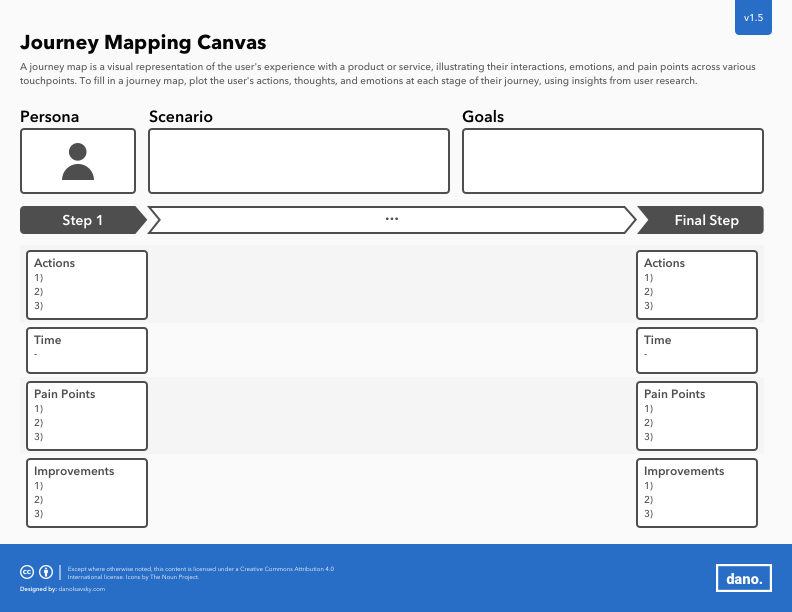
    A journey mapping canvas is a visual tool used to understand the experiences and emotions of customers or users as they engage with a product, service, or brand. Journey mapping is a customer-centric method that helps organizations gain insights into the touchpoints, pain points, and opportunities in a customer’s journey, and to identify areas for improvement.

    A journey mapping canvas typically includes information about the customer’s goals, motivations, and pain points, as well as the touchpoints that the customer interacts with during their journey. This can include physical touchpoints, such as retail stores or service centers, as well as digital touchpoints, such as websites or mobile apps.

    The journey mapping canvas is typically created by conducting research and gathering data from customers, either through interviews, surveys, or observation. The data is then used to create a visual representation of the customer’s journey, which helps organizations identify patterns, insights, and areas for improvement.

    Once the journey mapping canvas has been created, organizations can use it to inform product and service design, as well as customer service and marketing strategies. By understanding the customer’s journey, organizations can create a more seamless, efficient, and enjoyable experience for their customers, and improve customer satisfaction and loyalty.

    In conclusion, journey mapping is a valuable tool for organizations that want to understand their customers better and to create experiences that meet their needs and expectations. By using a journey mapping canvas, organizations can gain insights into the customer’s journey and identify opportunities for improvement, helping to drive customer engagement, satisfaction, and loyalty.

    Download Canvas (PDF):

    https://danolsavsky.com/wp-content/uploads/2023/02/User-Jouney-Mapping-Canvas.pdf

    This article is part of a series on Design Thinking.
  • Persona Mapping Canvas

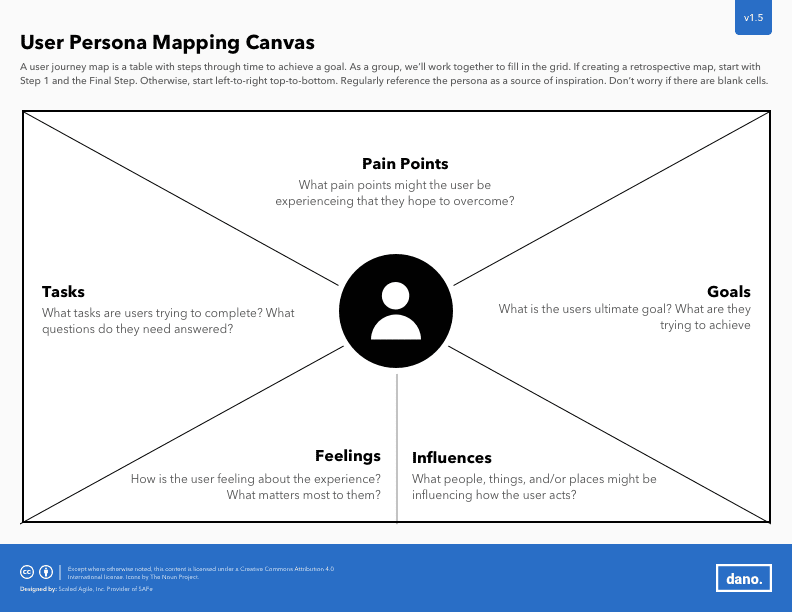
    A user persona mapping canvas is a visual tool used to understand and represent the needs, motivations, and behavior of a target user group. User personas are fictional representations of the target audience, based on data and research about their behaviors, goals, and motivations. By creating user personas, organizations can gain a deeper understanding of their target audience, and create products, services, or experiences that meet their needs and expectations.

    A user persona mapping canvas typically includes information about a user persona’s demographic information, behavior patterns, pain points, and goals. It also includes information about the touchpoints and channels that the persona interacts with, and the motivators and barriers that influence their behavior.

    The user persona mapping canvas is created by conducting research and gathering data from the target audience, either through surveys, interviews, or other methods. The data is then used to create a visual representation of the user persona, including demographic information, behavior patterns, pain points, and goals.

    Once the user persona mapping canvas has been created, organizations can use it to inform product and service design, as well as marketing and communication strategies. By understanding the user persona’s needs, motivations, and behavior, organizations can create experiences that are tailored to their target audience and that meet their needs and expectations.

    In conclusion, a user persona mapping canvas is a valuable tool for organizations that want to understand their target audience and create products and services that meet their needs. By using this tool, organizations can gain insights into the target audience and create experiences that drive customer engagement, satisfaction, and loyalty.

    Download Canvas (PDF)

    https://danolsavsky.com/wp-content/uploads/2023/02/Persona-Mapping-Canvas.pdf

    This article is part of a series on Design Thinking.
  • Affinity Mapping Canvas

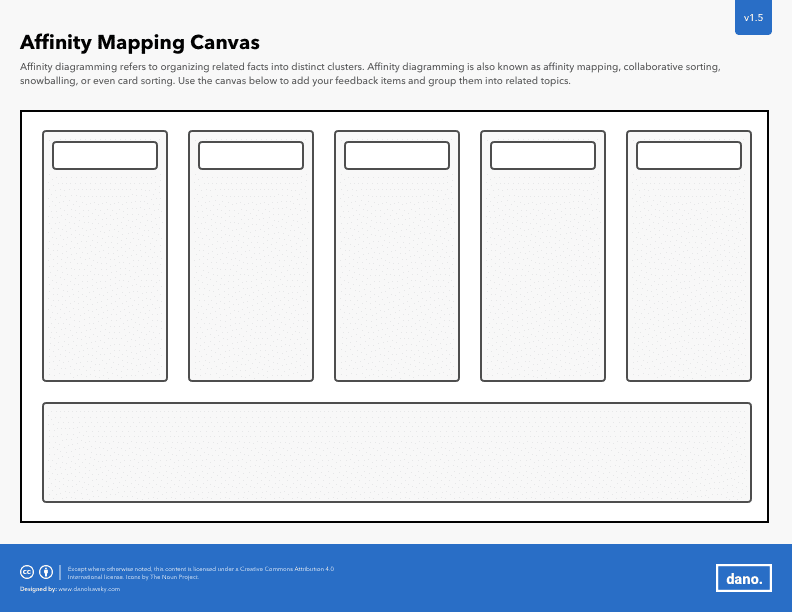
    Affinity mapping is a brainstorming and ideation technique used to organize and categorize a large number of ideas, observations, or inputs into groups or themes. The goal of affinity mapping is to identify patterns, connections, and relationships among ideas, and to categorize them in a way that makes sense and is easy to understand.

    The process of affinity mapping typically involves writing down all of the ideas or inputs on sticky notes or index cards, and then grouping the notes into related categories. This process can be done in a group setting, with participants working together to categorize the ideas, or it can be done individually, with each participant categorizing their own ideas.

    Once the ideas have been grouped into categories, the categories can be refined and consolidated until a clear and concise set of themes emerges. These themes can then be used to inform decision making, prioritize initiatives, or drive further ideation and brainstorming.

    Affinity mapping is a useful tool for individuals and teams who need to process and make sense of a large amount of information, ideas, or inputs in a short amount of time. It is also useful for facilitating group discussions and aligning stakeholders around common themes and priorities.

    Download the canvas (PDF):

    https://danolsavsky.com/wp-content/uploads/2023/02/Affinity-Mapping-Canvas.pdf

    This article is part of a series on Design Thinking

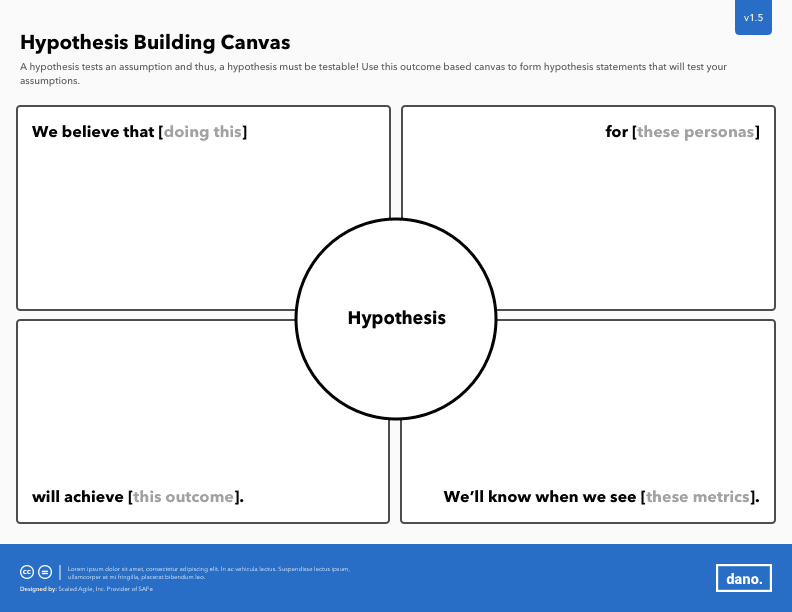
  • Benefit Hypothesis Building Canvas

    A benefit hypothesis is a statement that defines the potential positive impact or outcome that a product, service, or solution is expected to have on its intended users or customers. A benefit hypothesis is an essential component of product development and design thinking, as it provides a clear direction for the development team and helps ensure that the end result is aligned with the needs and wants of the target audience.

    A benefit hypothesis typically takes the form of “By [doing this], [these] customers will [achieve this benefit].” For example, “By providing a mobile app that helps users track their daily water intake, customers will be able to increase their daily water consumption and improve their overall hydration.”

    The benefit hypothesis is used to guide the development of the product and to test and validate the assumptions about the target audience and their needs. The hypothesis is tested and refined through user research, prototyping, and testing, and is updated as new insights are gained about the target audience and the product’s potential impact.

    In conclusion, a benefit hypothesis is a critical tool for ensuring that a product is developed with the user or customer in mind, and for ensuring that the end result meets the needs and expectations of the target audience.

    Download Canvas (PDF):

    https://danolsavsky.com/wp-content/uploads/2023/02/Hypothesis-Building-Canvas.pdf

    This article is part of a series on Design Thinking.
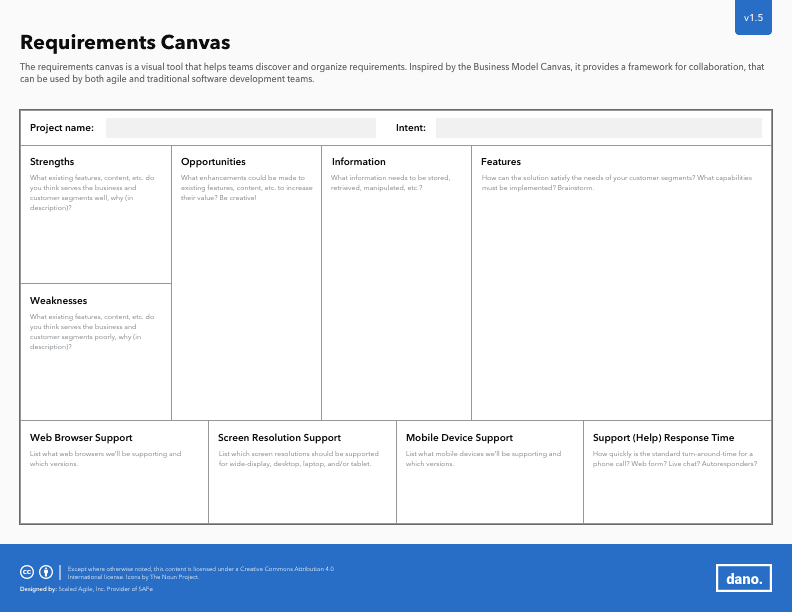
  • Project Requirements Canvas

    A Project Requirements Canvas is a visual tool used in the planning and management of projects. It helps to identify, gather, and organize the requirements of a project, including both the functional and non-functional requirements of the stakeholders involved.

    The canvas consists of several sections, including project goals, stakeholders, user needs, functional requirements, non-functional requirements, constraints, and assumptions. The tool provides a structured way to ensure that all relevant requirements are captured and considered in the project planning process, making it easier to manage the project and achieve desired outcomes.

    The canvas is often used in conjunction with other project management techniques, such as agile or waterfall methodologies, to help guide the project from conception to delivery.

    Download Canvas (PDF):

    https://danolsavsky.com/wp-content/uploads/2023/02/Requirements-Canvas.pdf

    This article is part of a series on Design Thinking.
  • Google HEART Metrics Canvas

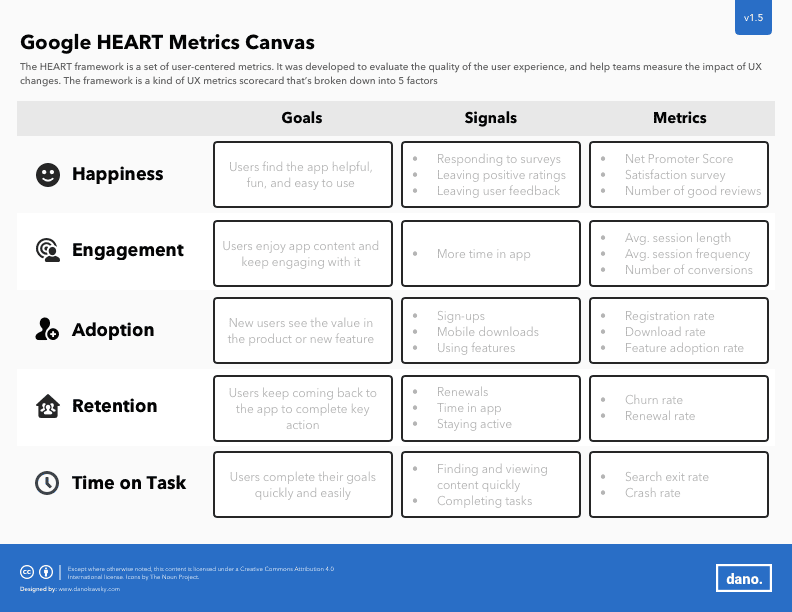
    The Google HEART (Happiness, Engagement, Adoption, Retention, Task Success) Metrics Canvas is a framework used by organizations to measure and optimize user experience and customer engagement. HEART metrics are a set of quantitative and qualitative measures that help organizations understand how users feel about their products and services and how effectively those products are being used.

    The framework focuses on five key dimensions of user experience:

    Happiness

    Measures user satisfaction, attitude, and perceived value through surveys, ratings, and feedback.

    Engagement

    Measures the depth, frequency, and intensity of user interaction with a product or service.

    Adoption

    Measures how many new users begin using a product or feature within a given time period.

    Retention

    Measures how often existing users return and continue to use the product over time.

    Task Success

    Measures how effectively users are able to complete intended actions, including efficiency, error rates, and completion rates.

    The HEART Metrics Canvas is flexible and can be adapted to different industries, products, and goals. Teams typically pair these high-level metrics with specific signals and goals so progress can be tracked in a measurable way.

    Organizations use the canvas to gain a clearer understanding of user behavior and sentiment, identify areas for improvement, and make data-informed product decisions. By consistently monitoring these dimensions, teams can align design and development efforts with real user outcomes rather than assumptions.

    Download Canvas (PDF):

    https://danolsavsky.com/wp-content/uploads/2023/02/Google-HEART-Metrics-Canvas.pdf

    This article is part of a series on Design Thinking.
  • Success Criteria Canvas

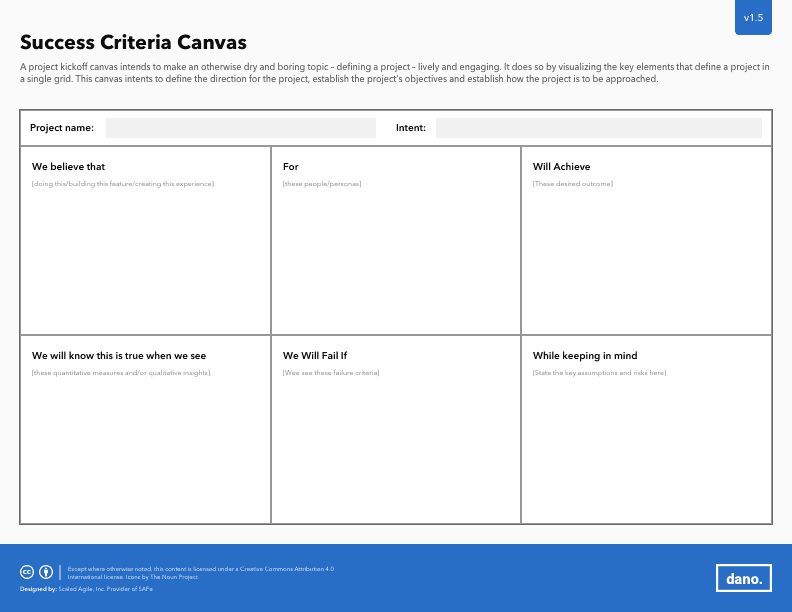
    A Success Criteria Canvas is a visual tool used to define and articulate the goals and objectives of a project, initiative, or product. It helps ensure everyone involved shares the same understanding of what success looks like and what needs to be achieved.

    The canvas typically includes sections such as:

    • Vision: the overarching outcome you are trying to create
    • Success factors: the key conditions that must be true for the effort to be considered successful
    • Success indicators: observable signs the work is moving in the right direction
    • Success metrics: how success will be measured and tracked over time

    This tool is especially helpful for aligning stakeholders, managing expectations, and preventing “moving goalposts” during delivery. When teams agree on success criteria early, it becomes easier to make tradeoffs, prioritize work, and evaluate progress with clarity.

    Download Canvas (PDF):

    https://danolsavsky.com/wp-content/uploads/2023/02/Success-Criteria-Canvas.pdf

    This article is part of a series on Design Thinking.
  • Project Kickoff Canvas

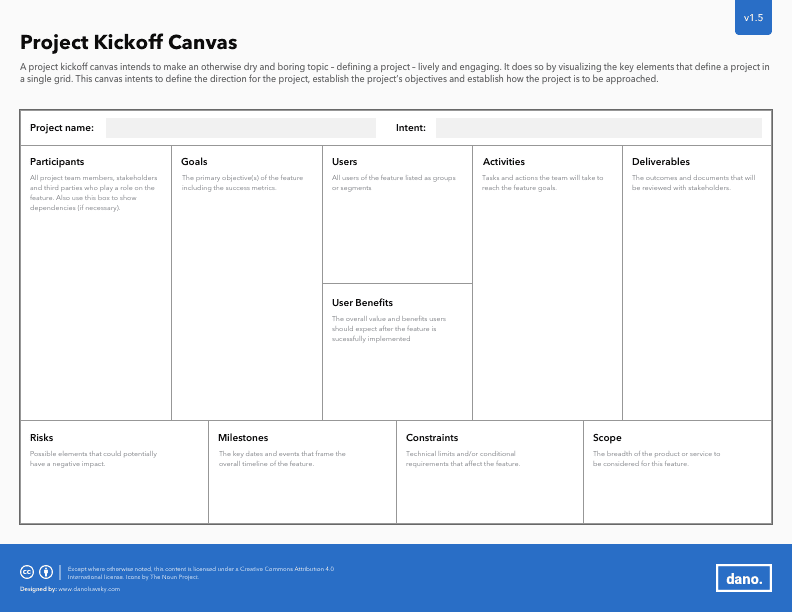
    A project kickoff canvas is a visual tool used to help teams align on the goals, scope, and plan for a new project. It provides a high-level overview of the project and helps ensure that everyone involved has a clear understanding of what the project is, what it is trying to achieve, and how it will be executed.

    The project kickoff canvas typically includes information such as the project objective, key stakeholders, timeline, budget, resources, risks, and assumptions. It also includes information on scope, including deliverables, milestones, and criteria for success.

    The project kickoff canvas is typically created by the project sponsor, project manager, or project team, and is reviewed and discussed with all relevant stakeholders, including team members, stakeholders, and clients. The canvas is used as a reference throughout the project to ensure that everyone is aligned on the project goals and progress.

    In conclusion, the project kickoff canvas is a valuable tool for ensuring that a project gets off to a good start and is executed in a way that meets the expectations of all stakeholders. It helps ensure everyone involved has a clear understanding of what they are working toward, and it helps teams work more efficiently and effectively by providing a shared understanding of the project goals and scope.

    Download Canvas (PDF):

    https://danolsavsky.com/wp-content/uploads/2023/02/Project-Kickoff-Canvas.pdf

    This article is part of a series on Design Thinking.
  • Value Proposition Canvas

    A Value Proposition Canvas is a visual tool used in the development of new products or services, or the improvement of existing ones. It helps define and articulate the unique value that a product or service offers to its target customers, and how it addresses their needs and wants.

    The canvas consists of two parts:

    Customer segment

    • Target customer segments

    • Their jobs, pains, and gains

    Value proposition

    • The products and services offered

    • Pain relievers and gain creators (how you reduce pains and create benefits)

    This tool provides a structured way to assess and refine a product’s value proposition, making it easier to communicate and test with customers.

    Download Canvas (PDF)

    https://danolsavsky.com/wp-content/uploads/2023/02/Value-Prop-Canvas.pdf

    This article is part of a series on Design Thinking.